
English concept: Synthetic Society · Trust Ops (T-Ops)
Keywords: generative content, credibility governance, RAG verification, content provenance, brand consistency, content safety
Introduction: When “content” can be mass-produced, trust becomes the first productivity
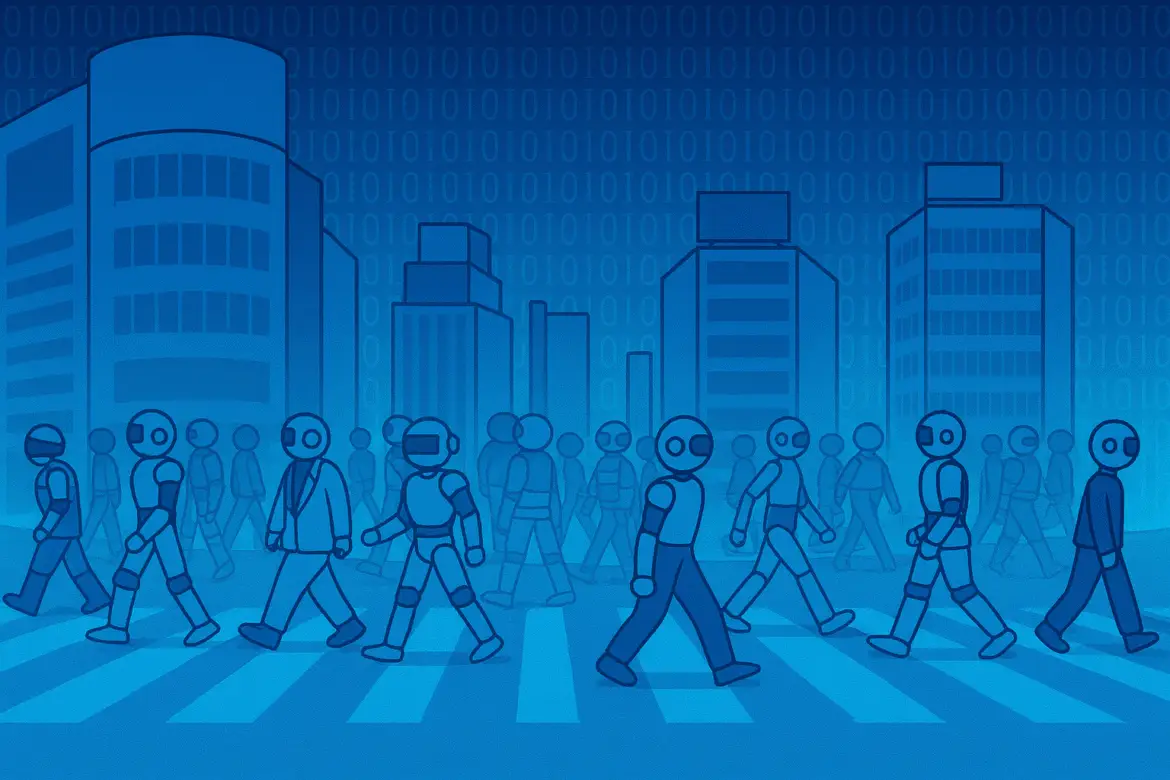
In just two or three years, generative AI has bent the content-supply curve hard into an exponential: text, images, video and audio, data summaries, and scripts appear at the same time, and the latency of communication inside and outside the organization is compressed into seconds. But the other side of speed and scale is that “semantic reality” is quickly diluted — more and more things look true, and the process of generation and the chain of evidence become harder and harder to see. So we walk into a new normal: a society of AI mass production (a Synthetic Society). Here, the question has long since ceased to be “can AI write.” It is “is what is written credible, traceable, auditable, and capable of bearing responsibility.” In this environment, a brand’s moat moves from content capacity to trust capacity.
NO° 01 | A crisis of content credibility: from an efficiency dividend to a trust deficit
Generative systems turn “creation” into “assembly,” “waiting” into “take it now,” and at the same time turn “error” into “an amplifier.” Incomplete sources are completed without awareness; an old standard is wrapped in a new style of writing; at first glance it is smoother, more human, more emotional, and yet it quietly shifts its ground on the data, the definition, and the attribution of responsibility. When such an output enters a critical touchpoint — a customer-service reply, a product-page description, an investor deck, a press release — a mis-citation, a wrong standard, is often retold and generated a second time in communities and in search, and within a few hours becomes a matter of public sentiment. It is the same inside the enterprise: different departments each use AI to draft content; the speed of iteration is faster, the splitting of the standard is faster, and what the brand says outward and the indicators it uses inward walk farther and farther apart. Without an auditable chain of evidence, the larger the scale of content, the deeper the trust deficit.
NO° 02 | Rebuilding the mechanism of trust: a “three-piece set” of institution, transparency, and culture
To pull trust back, what you rely on is not a tone that is more like a person’s, but “institutionalized traceability + transparency by default + a culture that can be sustained.” At the level of institution, first grade the content and set a chain of responsibility: cut all output by risk and sensitivity into high, medium, and low; high risk (legal, financial, medical, compliance) always goes through a dual-track process of “AI draft + human second review + comparison with an authoritative source”; medium risk is a fast review; low risk is automatic — but all of it leaves a trail. Every piece of outward content must be marked with “the degree of generative participation” (written by a person / person + AI / AI + a person) and “the person responsible for release,” turning who wrote it, who reviewed it, and on what basis, into an auditable asset. At the level of transparency, build a “source card” and a “correction mechanism”: outward pages and files, by default, show the main source, the definition of the standard, the time of update, and the unit responsible; once a correction is made, keep a correction statement that can be cited, and the difference between versions. At the level of culture, move from “pursuing zero error” to “timely acknowledgement and fast repair”: treat a correction as a capability, not a shame; set a 24-hour correction SLA and a public-response template for the front line, so that the outside can see the brand’s preference for truth and responsibility. At the same time, train internally “the recognition of hallucination,” “self-discipline about evidence,” and “consistent writing,” so that everyone knows: good content is not written out. It is proved out.
NO° 03 | Make RAG verification the default: let every sentence be “checkable against evidence”
In a Synthetic Society, without provenance there is no usability. Letting RAG (retrieval-augmented generation) become the default workflow of content production is the way to control risk at the root. The pipeline should look like this: first, semantically retrieve candidate passages from a whitelist of authoritative sources (a library of regulations, official manuals, internal policy, audited data tables); then let the model summarize and generate; finally, pack the cited passages, a timestamp, a version, and the standard together into a “provenance card,” and mark the confidence. When the evidence is insufficient or the sources contradict one another, downgrade to a refusal to answer, or to a state of “needs human reinforcement.” Never paste over it with a fluent assumption. The presentation at the front must be upgraded at the same time: at the bottom or in a side column of a product page, an FAQ, a white paper, or a deck, show by default “which sources this paragraph cites, the time of last update, and a hint of any difference in standard,” and put the explanation and the evidence in the same line of sight as the copy. On the evaluation side, do a periodic regression on “citation coverage, density of provenance, the rate of bad suggestions, and the calibration error of confidence”; when contradictions across sources climb, trigger arbitration by a committee on the governance of standards, and make sure that “the way of writing can be diverse; the standard must be unique.”
NO° 04 | An upgrade of the brand’s content strategy: not “produce more,” but “be cited credibly”
When the entrance moves from “a click” to “semantics,” and when consumption moves from “browsing” to “being served,” the contest of content is no longer who writes better, or who can pile up more volume. It is who can be cited by a model, repeatedly and credibly. This requires the brand to recast content from “friendly to the human eye” into a dual form of “friendly to the machine + credible to the human eye.” All FAQs, specifications, price terms, warranties, and cases must be sliced and annotated with metadata (applicable region, version, period of validity, chain of evidence), and a “machine-readable” version (JSON / YAML / a C2PA-like credential) must be output in parallel, so that a platform and an agent can pull it and use it directly. Video and livestreams should, at the same time, produce a timestamped script, annotations of key sentences, and tags of emotion and of audience, so that a “real experience” can be cited in slices, and does not only rely on a boost of heat. Tone and values also need a “semantic boundary of the brand”: regulate which metaphors, positions, and sensitive words are a forbidden zone, which styles are a spectrum the brand can accept, and settle this in the version of the prompt board. KPIs must also be converted: from PV / CTR to “the rate of being cited, consistency across channels, the coverage of explainable recommendation, and the conversion rate driven by a citation,” and bring “being trusted by the system” into the inventory of brand assets. When content begins to be called like an API, the brand’s competitiveness no longer depends on media spend. It depends on a “credible data layer.”
NO° 05 | An upgrade of organizational capability: turn content into a “safe production line”
Generative content is not a spark of inspiration. It is a production line that needs a shift on duty, inspection, regression, and a way to stop a loss. The enterprise needs to establish a system of “Trust Ops (T-Ops)” and a “content safety officer,” corresponding to process and yield management in a factory. The tasks of T-Ops include: inventorying and maintaining authoritative sources and black-and-white lists; building a canary-release and rollback mechanism, so that a new standard is first tested in a small-traffic environment; operating an observability dashboard, and in the weekly report regularly reviewing citation coverage, bad suggestions, a drift of confidence, differences across platforms, and the SLA for complaints; and pushing a “three-layer risk” flow — high risk on a dual track, medium risk on a fast review, low risk automatically cleared but with a trail on the whole journey. In addition, red-team testing must become normal — a reverse offense and defense against a key question bank of the brand’s sensitive zones, legal high ground, and comparisons with competitors, to make sure that under pressure the system chooses “pause and verify,” not “invent and brush off.” Crisis drills also need to be standardized: SOPs and dialogue templates for withdrawing a piece, correcting, apologizing, and compensating must be run in ordinary times, so that when something truly happens, every department is not improvising on its own.
NO° 06 | A manager’s action list: design “credibility” as a product feature
The real turn is from treating trust as a “slogan” to treating it as a “product specification.” First do a grading of content and a framework of responsibility, and make clear who generates, who reviews, who releases, and who endorses. Productize the RAG pipeline, build a whitelist of authoritative sources and a rule for refusing to answer, and make “no evidence, no output” the default. Slice FAQs, policies, specifications, and cases in a structured way and annotate them with metadata, and output a human-eye version and a machine version on a dual track. Establish T-Ops and a content safety officer, and hang a quality board and a rollback mechanism on them. Outward, default to transparency: a mark of AI participation, a watermark or a signature, a correction statement, and the management of consent. Settle an evaluation set and a red-team set, and do periodic regression. Regularly run a “drill of the brand’s standard,” and make sure departments are consistent on key questions. When these become everyday, the brand not only writes quickly and publishes widely. It can also “prove it.”
Closing: In an age of content flood, credibility is the scarce good
A Synthetic Society is not a disaster. It is a demand that we rebuild trust with a new order and new tools. Explainable, traceable, and governable will become the basic literacy of content. Being cited by a model, being trusted by a platform, and being believed by a consumer will become the core assets of a brand. The earlier an organization “engineers + governs” the production of content, the more it can turn AI from a source of risk into competitiveness, let speed serve the truth, and let scale carry responsibility. When every sentence comes with evidence and a boundary, the brand’s long-term trust, and its compound return, truly begin to accumulate.
More deep-dive pieces
- ChatGPT will now show brands how often they are mentioned. That is not proof they were recommended well.
- AI will not only eliminate people: the functions being enhanced, and a manager’s handbook for this week
- AI unemployment ranking: the high-risk functions most likely to be eliminated or largely replaced
- Will AI cause unemployment? Start with the enhance / accelerate / eliminate axes
The judgment, restated
My judgment is that everyone has content capacity; trust capacity is the moat — what you compare is not volume, but evidence and a boundary.
Three things this week
- Inventory one chain of provenance for an output (source / timestamp / an auditable path).
- Set a cross-department brand standard (who can say what outward).
- Put up a metric of “the rate of being cited,” and stop looking only at volume of publication.
If you too are turning trust into product power, you are welcome to subscribe to Future Insights Lab, or to reply and discuss your T-Ops sticking points.