
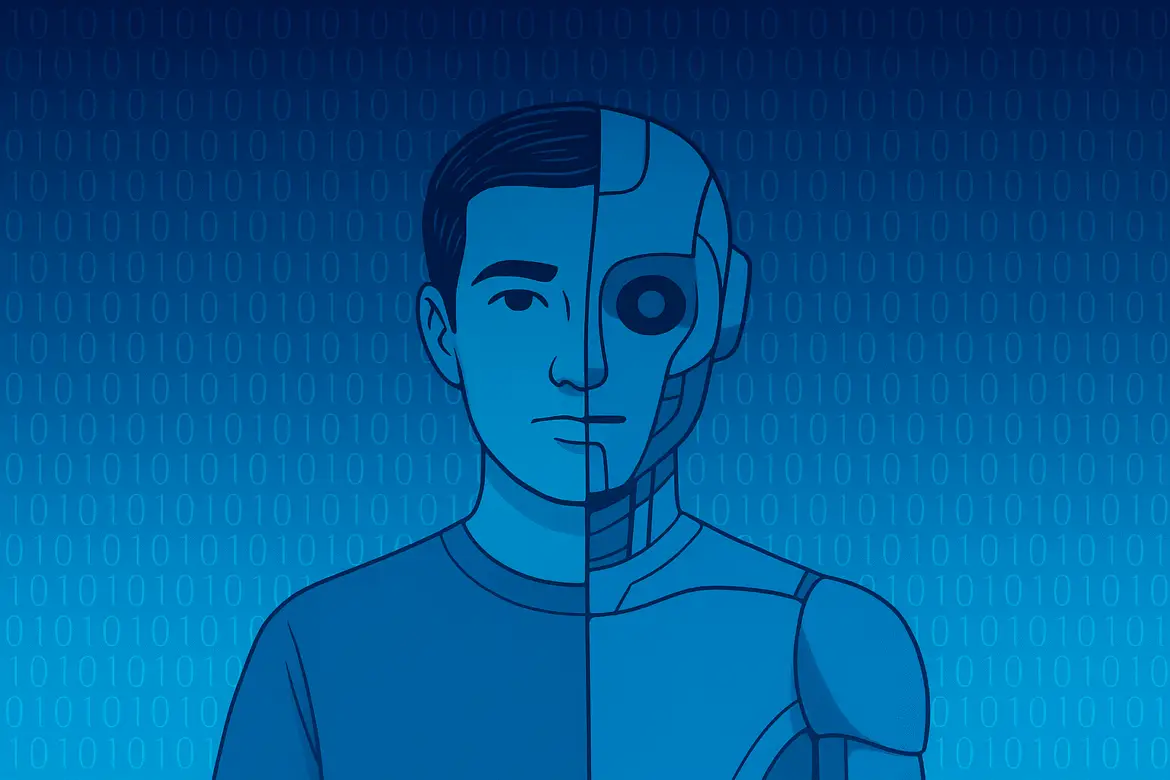
English concept: Personal OS · Digital Twin
Keywords: personal agent, long-term memory, cross-device collaboration, intent agency, revocable authorization, BYOAI (bring your own agent)
From “a person who uses tools” to “a person who brings a teammate”
For the past twenty years, our relationship with the digital world has been that a person goes looking for an application, and the application waits for an instruction. Accounts are static, data is fragmented, and processes are glued together by human effort. In the next three to five years, this relationship will be thoroughly turned over: AI will no longer be a tool called in for a moment, but a Personal OS that resides on all of your devices and accounts. It has long-term memory, it can understand your tone and your preferences, it will dispatch services in the background, and it will communicate and execute safely in your name. For Taiwanese companies and consumers, this means two lines advancing at once — one is the programmability and expansion of personal capability; the other is the rewriting of the organization’s boundary and of how a process is orchestrated.
Everyday digital scenes in Taiwan are highly fragmented: Teams or Slack at work, an official LINE account for outward contact, e-commerce switching among momo, PChome, and Shopee, payments flowing among LINE Pay, JKOPay, and Apple Pay. The value of a Personal OS is precisely this: to build a semantic bus in such a multi-end, multi-account environment, so that “I” am no longer cut up by tools, but unified by memory and intent. From then on, employees and consumers will carry a “digital self” into the scene of a transaction and of work. Enterprises will no longer be able to design only “pages and processes.” They will have to design “how to collaborate with a person’s personal agent.”
NO° 01|From a “toolbox” to a “digital self”: personal long-term memory becomes a default capability of the system
The core of a Personal OS is not a new app. It is a Memory Graph: your habits of address, your writing style, your standard for expense claims, your frequent templates, your counterparts, your price floor, your health and diet preferences, gradually structured into semantic nodes that can be cited. In the past, every task started from a blank page. Now the input can be shortened to “half a sentence” — “help me write a board presentation, keep last time’s tone, and add Q2 data on the Taiwan market.” The system will automatically pull the company knowledge base, the calendar and email traffic, and the tone and layout of past decks, first hand over a draft that is 80% usable, and then invite you to fine-tune it.
This pattern of “make a sample first, then personalize” is especially critical in Taiwan’s highly multilingual work environment. A Personal OS can keep terms and standards consistent across Chinese, English, and Japanese, and keep format and tone consistent across brands and business groups, lowering the cost of correcting communication across teams. When an employee moves or leaves, personal memory can, under compliance, be handed over as a “migratable asset,” so that key methods and tacit knowledge no longer scatter in a person’s head and in old mail folders, but can settle into a style and a process the organization can reuse.
For the individual, the value of long-term memory is fewer repeated explanations. You no longer have to tell the system, again and again, whether you prefer PMingLiU (新細明體) or Source Han Sans (思源黑體); you no longer have to restate that the cover of a deck uses deep blue; you no longer have to paste in that fixed clause on contractual liability. For a manager, memory means consistency of quality: the tone, citations, and layout of documents in the same department can reach an organization-level standard, and the details of what the brand puts out no longer vary with the person.
NO° 02|From passive execution to active agency: personal tasks are “taken over in the background”
A Personal OS does not only answer questions. It will act in advance, and prepare in advance. You settle next week’s meeting in Taichung with a colleague on LINE; it will automatically draft the schedule, assess the THSR time slot, the weather, and parking, generate a travel request, and pre-fill electronic invoices and lodging information in the company’s expense system. You finish a cross-department meeting; it extracts decision points and owners from the minutes, dispatches task cards to each person’s board, and three days later reminds you to follow up, with a screenshot of the latest KPI and a variance analysis attached. You say “finish the Q3 e-commerce review before the end of the month”; it will first pull GMV, conversion rate, and return rate from momo and Shopee, add the heat of customer-service sentiment, and hand over a first draft that can be presented.
This kind of active agency needs a clear “study of exceptions.” A Personal OS must know which things can be released automatically (for example, a fixed monthly subscription of a small amount, or a payment to a regular vendor), which things only offer a suggestion (for example, a purchase when the budget is near its ceiling), and which things must be confirmed a second time (for example, sending a letter outward, a remittance to a company, or re-signing a contract). A good Personal OS should leave your attention for exceptions and decisions, and let everyday mechanical actions disappear as far as possible. In management, the enterprise’s performance indicators will change with this: from counting the volume of work completed, to measuring the coverage of automation, first-pass rate, and the rate of exceptions, and freeing people for the places that need judgment and creativity.
On the consumer side, a Personal OS will also turn tedious upkeep into “continuing small matters.” It knows that the stock of formula at home is falling, that the rainy season is coming, that a neighborhood event is this weekend, and will, at the right moment, give a corresponding shopping list and a reminder of the schedule. In a Taiwan medical setting, it can arrange the key indicators of a health-check report, compare them with the recommendations of the Health Promotion Administration, and prepare the points to ask at the next visit. You are no longer pushed along by an app’s notifications. Services are driven by your own intent and rhythm.
NO° 03|A cross-device semantic bus: glasses, a watch, a car system, and the home become “the same I”
Mobile scenes in Taiwan are highly fluid: switching between a scooter and the MRT on a commute, moving between the office and a café, opening CarPlay in the car, speaking to a smart speaker at home. The second main line of a Personal OS is to string these devices into a semantic bus. Glasses and earphones provide input and feedback with the lowest friction; a watch and a car system take on short-turn tasks; a phone and a desktop finish long tasks and a second review. On the MRT you say into an earphone, “arrange the three conclusions of the meeting just now, and send them to A and B”; at the office computer you can already see a formatted draft of the mail. In the car you have the system read out a weekly report on competitors; when you enter the office, the points and the corresponding tasks pop up automatically.
The key across ends is not syncing files. It is a continuous context: the system knows what scene you are in, the current load on your mind, and the available way of input, and so switches to the most suitable presentation. In the car it does not pop a long table; it plays a summary. On the desktop it no longer plays audio; it shows an editable table. In a meeting it uses a floating layer to hint at a key number, and only after the meeting does it push a full record. A small on-device model handles short-horizon reasoning; going to the cloud completes complex computation, to lower latency and protect privacy. From a product point of view, an enterprise needs to provide a consistent interface that can be called from many ends, so that a personal agent can connect seamlessly to CRM, ERP, expenses, a knowledge base, and other systems, rather than forcing the user to walk the process again on a different screen.
NO° 04|A new boundary of authorization and identity: “I’ll handle it for you” must be controllable, revocable, and accountable
When a personal agent sends mail, places an order, signs off, or speaks outward “in your name,” the governance of authorization is the life-or-death line. In the context of Taiwan’s Personal Data Protection Act (PDPA) and the government’s MyData circulation mechanism, enterprises must write “consent, least privilege, audit, and revocability” into the system. A good Personal OS should provide fine-grained consent (allowing only the calendar to be read, not mail; allowing an order only within a specified amount), a time limit (one-time, or valid within seven days), a full trail (who, when, on whose behalf, what was done, on the basis of what data), and, before every high-risk action, an explainable reason card.
For a manager, this is not only a matter for the security department. It is also a matter of the brand’s trust. The enterprise needs a cross-department ledger of authorization and a risk-control register: treat the interaction of personal agents, enterprise agents, and third-party platforms as an auditable process chain, so that when a mis-send or an overreach appears, you can quickly locate which node made a wrong decision, and how to roll back and repair it. At the same time, you must design a user experience of “revocable by default”: any person or enterprise can cancel an agent’s access with one click, and the revocation takes effect at once and is broadcast to the systems already connected.
NO° 05|The organization’s connections are rewritten: employees and customers both come to collaborate with a “digital twin”
When BYOAI (Bring Your Own AI) becomes the normal state, collaboration will move from “person to person” to “person + agent to person + agent.” A customer’s personal agent will first work out a draft with the brand’s customer-service agent on warranty terms and lead time, and leave the dialogue and the basis; a supplier’s agent will read your purchasing standard and ESG terms, and return a compliance comparison report directly; the gathering of materials before an internal project meeting, the alignment of versions, and the follow-up after the meeting will first be exchanged among the respective agents, and a person’s work becomes decision and trade-off.
This requires the enterprise to upgrade its systems to be agent-ready. First, provide an Intent API — describe executable actions and the parameters needed in semantics, not in pages, so that an agent can get things done steadily and safely. Second, build a layering of trust — write the three levels of fully automatic, needs review, and suggestion only into policy, and monitor, with metrics, an agent’s first-resolution rate, rate of exceptional intervention, and rate of hitting compliance. Third, redefine the service experience — do not only design a UI for a user to look at; also design “a manual for an agent to read”: a contract of actions, error codes, a rollback strategy, an SLA, and a template for explanation, so that the three-party process of person, machine, and machine can be observed, rehearsed, and continuously improved.
NO° 06|A manager’s action list: switch from page thinking to capability thinking
Landing in the age of the Personal OS is not making another app. It is breaking enterprise services into a set of capabilities that a personal agent can dispatch at any time. The first step is policy and architecture: publish a BYOAI access policy, and distinguish systems that can be connected from data domains that cannot; build a personal semantic file and a ledger of consent, and regulate what is remembered, how long it is kept, and who can call it. The second step is interfaces and knowledge: break high-frequency processes into a contract layer of intent—parameter—action, and turn FAQ / terms / SOP into knowledge chunks that can be retrieved by RAG, with source, version, and confidence attached. The third step is on-device first, and audit: sensitive data and short-turn reasoning are handled on the device; anything that goes to the cloud is desensitized; the full chain leaves a trail, and visual revocation and appeal are provided. The fourth step is operations and measurement: bring the coverage of automation, first-pass rate, the rate of exceptions, the rate of being dispatched by an agent, the rate at which errors can be explained, and NPS into the KPIs, with periodic regression and red-team drills. Finally, please treat migratability as a design of an asset: when an employee moves, a vendor is replaced, or a customer goes offline, how personal and enterprise memory is safely transferred or destroyed must have an SOP.
Closing|When the boundary expands outward, competition moves from “a faster click” to “understanding me better”
A Personal OS is not making the app thinner. It is digitally thickening “the person.” It is not making the system noisier. It is making the background understand more. When employees and customers both come to interact with you bringing an AI teammate, the key to the next round of competition is not whose model is larger, but who is earlier trusted by the “digital self,” and dispatched at a high frequency. This shift will shorten the chain of decision, make the handling of exceptions visible and controllable, and also push the trust engineering of the brand and the organization to the front of the stage. Finish first the switch from page thinking to capability thinking; do authorization, audit, and revocability well first, and you can, in a world of multi-threaded human–machine coexistence, hold the new entrance and the engine of growth.
More deep-dive pieces
- ChatGPT will now show brands how often they are mentioned. That is not proof they were recommended well.
- AI will not only eliminate people: the functions being enhanced, and a manager’s handbook for this week
- AI unemployment ranking: the high-risk functions most likely to be eliminated or largely replaced
- Will AI cause unemployment? Start with the enhance / accelerate / eliminate axes
The judgment, restated
My judgment is that a digital twin lets the “multi-threaded person” enter the field; if the organization does not first do authorization and revocability, it will be dragged down by its own agents.
Three things this week
- Draft a BYOAI boundary (which data / actions cannot be delegated).
- Set a process of revocable authorization (who approves, and how it is taken back with one click).
- Pick one cross-end intent pilot (one work scene and one consumption scene).
If you are preparing to welcome employees and customers who “bring a teammate to work,” you are welcome to subscribe to Future Insights Lab, or to reply and discuss the sticking points of governance.