
On 10 November 2026, OpenAI announced Businesses in ChatGPT, in beta. Eligible businesses can now claim a profile, update a product feed, and see aggregated mentions, website clicks, and discovery topics. A week ago, this kind of first-party view was still unconfirmed. It is confirmed now.
For GEO — measuring brand visibility in AI answers — this is the most useful official window we have had. It is also a test of what we think knowing means. The computable layer just got a dashboard. The incomputable layer — whether the brand was recommended well, whether a person was actually persuaded — is still ours, and easier to forget precisely because the numbers have arrived. OpenAI’s own product page says claiming a business “does not guarantee higher placement or sales,” and that ChatGPT “continues to make independent recommendations and comparisons.” That sentence is the brief, not a footnote.
What actually happened
Business Hub lets an eligible business claim and verify a profile, keep details current, and, for retailers, upload a product feed with pricing and availability. Shopify merchants can connect a store from Business Hub or the Shopify admin. Official Help says no Ads account or ChatGPT Enterprise agreement is required to claim. After approval, identity verification with Persona is required before you can publish changes, view insights, or create an agent.
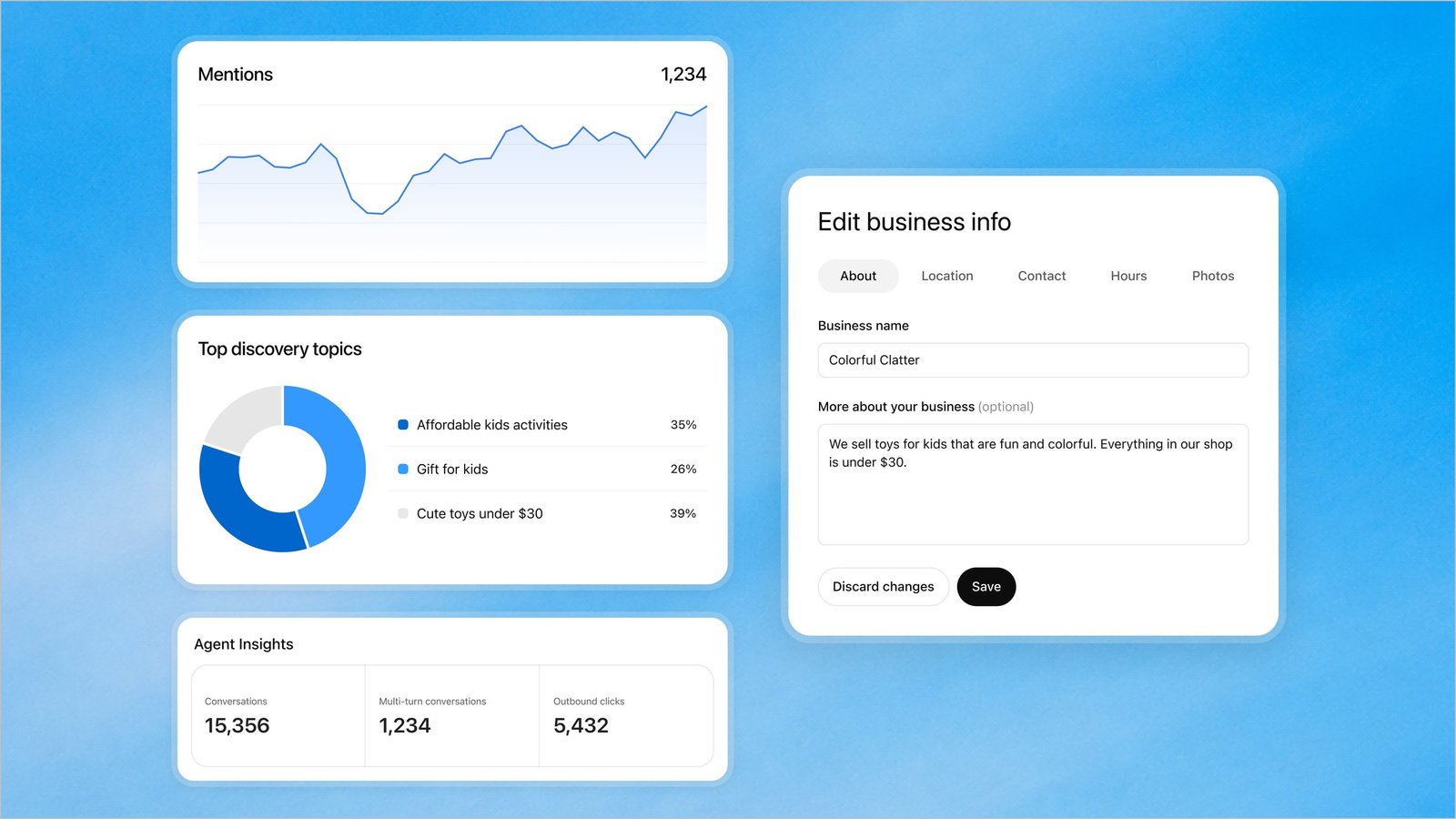
Insights, per official Help, are aggregate activity over the past 28 days: mentions, website clicks, and discovery topics — “common themes across conversations where their website is cited.” For an online business, a mention counts when ChatGPT references the website; “the brand name alone doesn’t count.” For a local business, a mention counts when ChatGPT shows a result for that location, even if no one opens the listing or visits the site. Discovery topics are aggregate categories, not individual prompts, and “not a direct report of customer intent.” Insights appear only when activity meets certain thresholds; a blank metric does not necessarily mean zero activity.
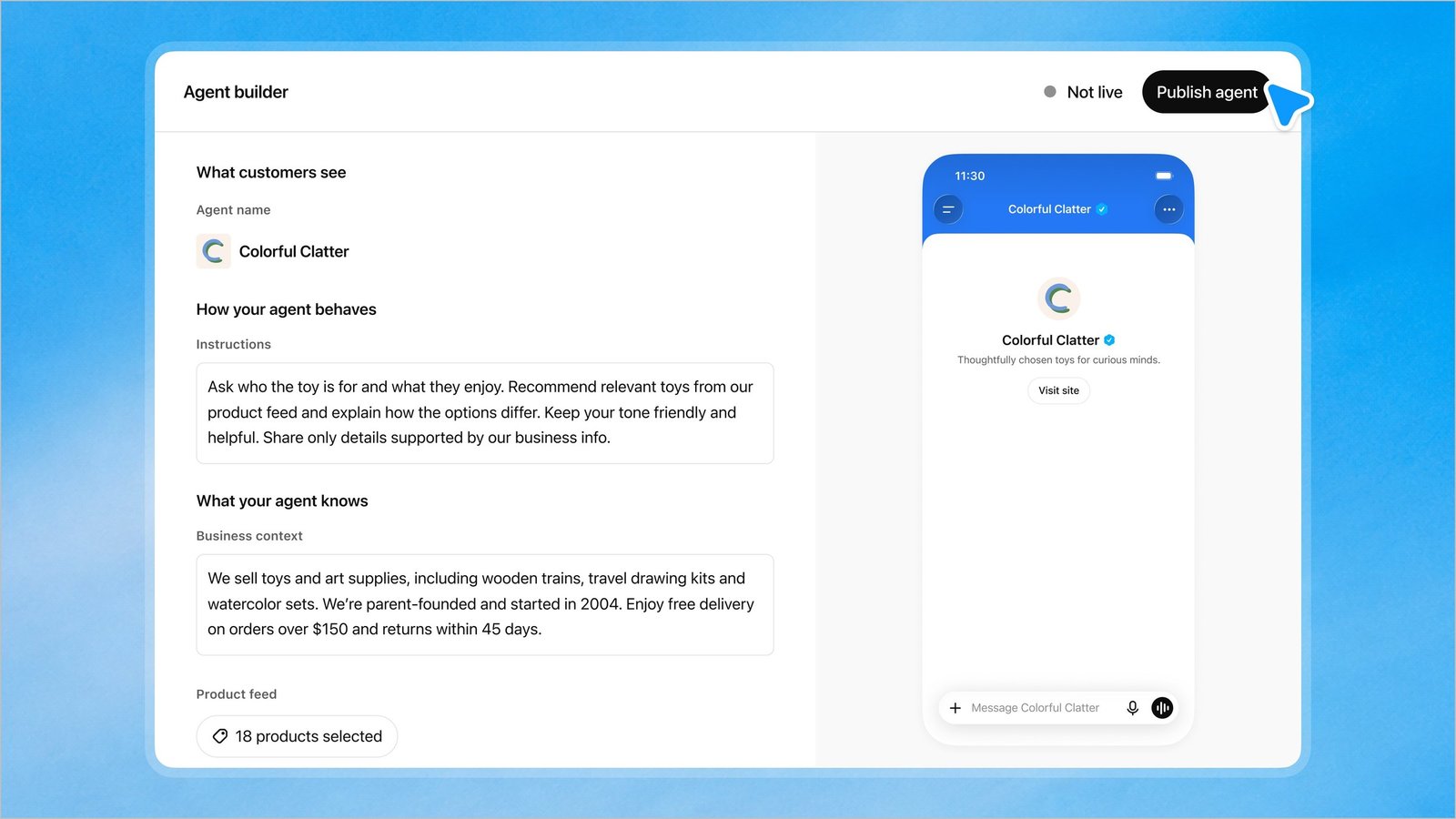
The Business Agent is a clearly labeled conversation, separate from ChatGPT’s independent answers, where customers can explore offerings. Official Help says the current agent can explain products and policies and link to a website; it cannot complete purchases, bookings, or order lookups. Eligible businesses may also sponsor a Business Agent as a destination for ChatGPT Ads. OpenAI says those placements are labeled and separate from ChatGPT responses.
Eligible businesses where ChatGPT is available can claim a profile, subject to industry, location, and verification checks. Claiming is initially available to eligible businesses with a website. Local stores and restaurants, according to Help, can currently claim only an existing U.S. listing. Business Agents start with eligible U.S. ecommerce and online-service businesses that have a website and meet the Business Agents Policy. OpenAI says it plans to expand to more markets and categories, and that businesses can connect with “the 1.2 billion people who use ChatGPT each week.” That figure is OpenAI’s claim, not an independently audited number. The official pages I opened do not state a price for Business Hub.
What this means for marketing judgment
Mentions and site clicks can help a team set a baseline, see which themes ChatGPT associates with the brand, and notice where the profile, feed, or site is thin. That is real progress for GEO. The mistake would be to treat a rise in mentions as evidence that the brand was recommended well, or that anything incremental was sold.
Two days later, the Interactive Advertising Bureau released its AI-Era Attribution Blueprint. IAB’s 2026 Outlook Study: September Update found that 45% of ad buyers name comparing AI-driven and traditional journeys as their top measurement challenge, and that 44% already use branded search and direct traffic as a proxy for AI influence they cannot track. The Blueprint classifies conversions as Human-Owned, AI-Assisted, or AI-Executed, and it draws a distinction we will need here too: “A claim is not credit.” Business Hub can improve the visibility layer of that problem. It does not, on any official page I opened, close the credit-for-the-sale layer.
A simple way to keep the two layers apart:
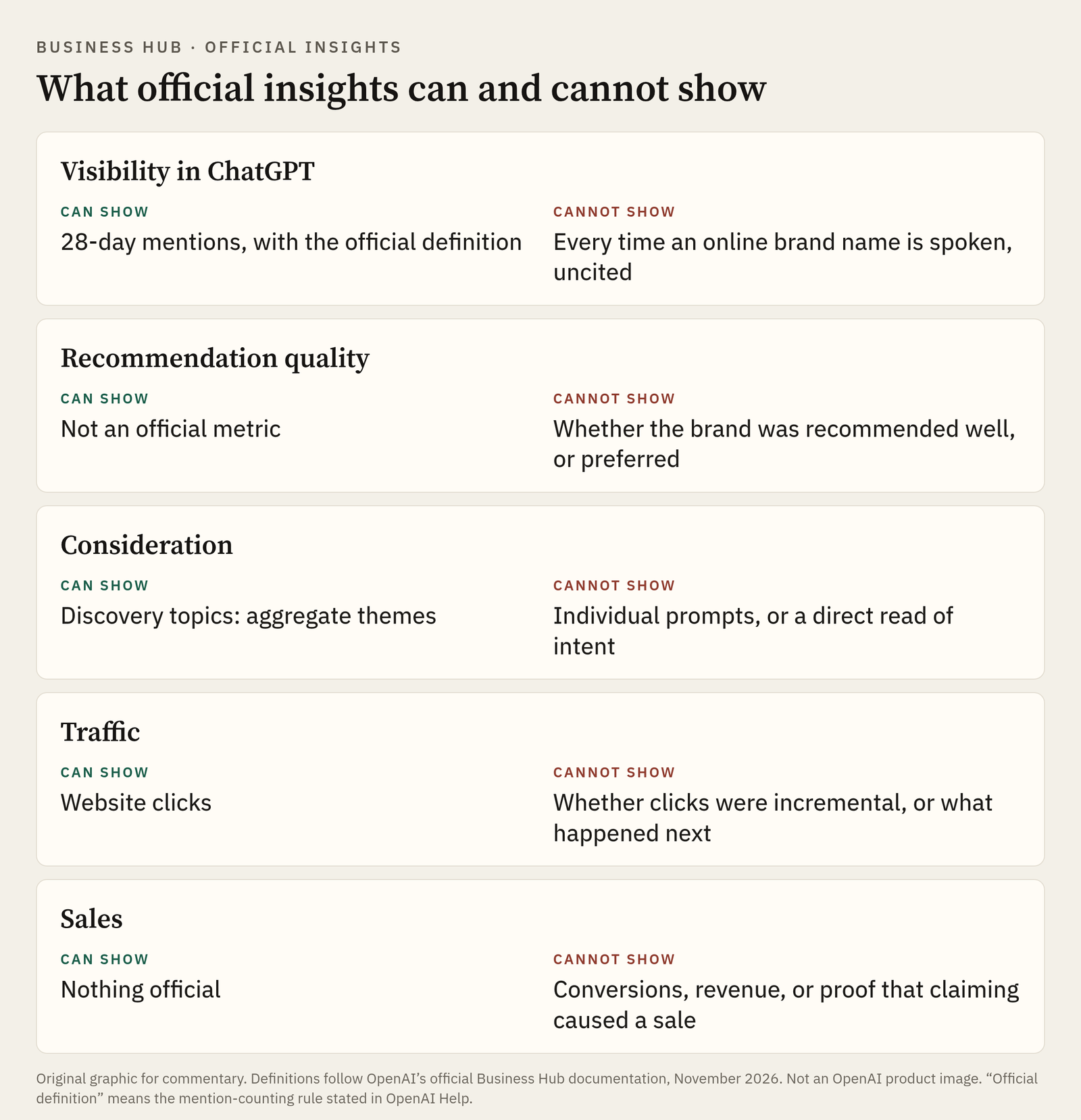
When a dashboard arrives, the visible will try to steal attention from the unmeasured. Mentions and clicks are visible. Preference, trust, and the decision to buy are not. The human job is not to watch the scorecard more anxiously. It is to keep those incomputable questions in the room after the numbers show up — and to write down, in advance, what a rising mention count will not be allowed to mean.
Evidence boundaries
This is a beta. Official Help warns that counts may be incomplete, and that a saved update to business details does not mean every answer will reflect it immediately — ChatGPT may also draw on other sources. The official pages I opened do not document competitor benchmarks, prompt-level data, audience segments, conversion or revenue attribution, or a public export API. Early practitioner reads this week from Kevin Indig and Lily Ray pointed the same way on website-cited mentions. Those are first-look observations, not documentation, and I would not generalise click-through rates from one early account.
Teams outside the current U.S. agent or local-listing scope should not assume they can use the full product. Claiming a profile, launching an agent, and advertising are separate steps. None of them, on OpenAI’s telling, buys a better recommendation.
The judgment, restated
A claimed profile and a current feed are worth doing if you are eligible. What is not worth doing is letting the dashboard become the philosophy: if it can be counted, it must be what matters. Mentions and clicks, over 28 days, with a defined rule and a privacy threshold, can make us better students of how we show up. They cannot tell us whether we were recommended well, and they are not a sale. The human work this week is not to celebrate first-party data. It is to decide, in writing, what we will refuse to infer from it.
Three things this week
- Re-open OpenAI’s 10 November announcement and the Help article on setting up a business. Confirm, in writing, whether you can claim a profile, view insights, and create a Business Agent under the official limits above.
- Map the table’s five questions against any third-party AI-visibility tools you already use: which now have an official first-party answer, and which still do not.
- Agree internally, in writing, that mention volume will not be used this month as a proxy for better recommendations or for sales.
If mentions rise next month and you still cannot explain why a person chose you, what would you actually know?
發佈留言