
Five Generations under AI | Start here (this piece)
70後 → 80後 → 90後 → 00後 → 10後 → Five generations in concert (this piece)
Introduction|An age with few clear rules, and full of enormous change
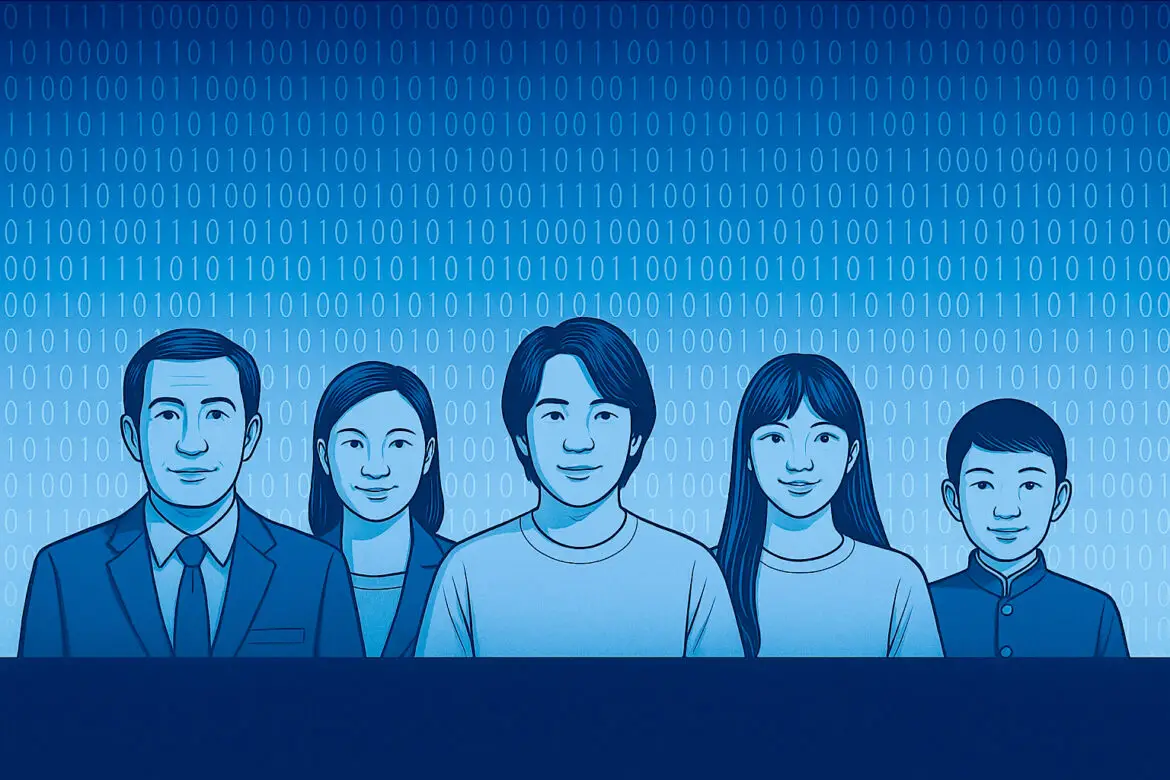
In Taiwan’s meeting rooms, Slack channels, and online town halls, five generations — from people born in the 1970s through the 10後 — are online at the same time: some are used to reporting up, layer by layer; some insist on iterating quickly; some understand the world through the logic of a platform; some drive a system through a semantic interface. Generative AI and multi-agent systems are rearranging power and process, and letting the work languages and the identifications of value of different generations collide often. This is not a multiple-choice question of “who is right and who is wrong.” It is a systems-design question of “how to live and flourish together.” If the earlier pieces discussed each generation’s individual proposition, what this piece has to answer is how five generations can form a true complementarity in the age of AI: not wearing one another down, but gathering into an organizational ecology that is smarter, warmer, and more resilient.
NO° 01|The world in the eyes of five generations: one another’s “original operating systems”
Imagine the underlying logic of each generation as an OS, and the difference becomes concrete and felt. The 70後’s operating system has structure and discipline at its core, and is extremely sensitive to a standard and to reliability. The 80後 work both sides between structure and flexibility; they are good at taking a frame apart, and they know how to translate at both ends. The 90後 are native users of platform grammar, and they emphasize individual narrative and being driven by meaning. The 00後 take mixed skills as the normal state, and cut a task into modules that can run in parallel. The 10後 go further: they treat language as an API and intent as an interface, and they are agent natives. When five operating systems are forced onto one network, misunderstanding is almost inevitable: what looks like “risk control” in the eyes of the 70後 looks like “inefficient delay” to the 00後; the creative narrative the 90後 are proud of may, in the ears of the 80後, lack governance and executability; the 10後’s intuitive reliance on AI is easily read by the 70後 as “outsourcing too much, and losing the gate.”
When we begin to learn one another’s language, however, difference turns into an asset. The 70後’s institutional sensitivity and long-termism are the base on which “a way of playing with AI” becomes “a rule for AI.” The 80後 can split a goal from a path, and translate human speech and machine speech into each other. The 90後 can say clearly why there has to be change, and turn a consensus into a narrative of mobilization. The 00後 can get a process running, and close the exceptions. The 10後 remind us that human–machine coexistence is not a slogan. It is a way of collaborating that can be practiced every day. When five operating systems are connected to the same task map and the same set of metrics, a cross-generational team is no longer a cost of communication. It is a dividend of speed.
To get there, feeling has to be turned into design. Rather than complaining that “they just don’t understand,” ask: “which layer of protocol are we missing?” A cross-generational protocol that can run usually contains three elements: a shared purpose (what it is for), a decision node (when to make a trade-off), and evidence that can be traced (how to check). As long as these three things can be landed in black and white, five operating systems can be connected under the same API, and misreading will fall quickly.
NO° 02|A shared cultivation of the age: complementary capabilities, and the possibility of collaboration
On a day when AI is gradually becoming a second work queue, complementarity among people is still more precious. The 70後 are best at settling “experience” into “institution.” If they can take one step further, and distill years of judgment into a decision template, an audit rule, and a governance boundary, they can write tacit wisdom into RAG and a process engine, and upgrade from keepers of the rule to designers of the rule. This is not only “handover.” It is writing what can be reused, supervised, and traced into the organization’s DNA.
The 80後’s role is like a bridge, and also like a fulcrum. They are familiar with reporting in a hierarchy, and they also understand the grammar of agility. They can break a strategic sentence into an executable tree of tasks, and compose people, data, and tools into a closed loop. When the 80後 learn to describe change in an “architectural language” — for example, the grading of permissions, the escalation of exceptions, a risk threshold, and an observable metric — the organization has a construction drawing that can run across generations.
The 90後 are the cultural hub of a new order. They can tell “why we have to change” as a story, and turn “where the change is going” into a set of visible milestones. When the 90後 translate an AI workflow and a governance rule into a rhythm and a ritual the team can see (a weekly demo, a monthly review, a quarterly retraining), they can turn innovation from “a one-off project” into “a continuing habit.”
The 00後 are the front-end executors of a hybrid power. They cut the task small, connect the nodes smoothly, and let the workflow actually run. If they can, at the same time, practice context and an acceptance metric, and bind fast output to being able to be trusted, they can upgrade from an “efficiency island” to a “system hand who can pass the baton.”
The 10後 will, in the end, be a new species of human–machine coexistence. They naturally drive a system with language. If they practice early a sense of boundary and a sense of purpose — which experiences must not be outsourced, which choices must be borne by a person, which relationships need to be face to face — they can raise “can use” to “can conduct, can co-build,” and become the stage designers of a small ecology.
NO° 03|The organization’s future: not younger, but more “generationally intelligent”
A truly intelligent organization does not only hire the youngest people. It lets every generation “plug in AI” at its own comparative advantage. This needs a sustainable strategy of generational intelligence (Generational Intelligence). First, bring in a dual-mentor system, and let teaching and learning flow both ways: seniors output strategic judgment, institutional design, and an ethical boundary; juniors feed back a tool stack, platform insight, and a method of experiment. Two-way pairing is not ordered by rank. It is ordered by scene. Each pairing produces a reusable artifact, such as a decision checklist, a workflow template, or a risk whitelist.
Second, rebuild a language of collaboration and a protocol of trust. Translate “trust in a person” into “trust in a process and in evidence”: before a meeting, use one page to align the goal, the assumption, and the metric; in the meeting, make trade-offs with observable data; after the meeting, write the experience back into the knowledge base and the workflow. When trust has an observation panel, intergenerational friction is no longer a quarrel about values. It is a debate about evidence, and winning or losing becomes a collective increment of learning.
Finally, make multi-generational co-creation a mechanism. When a project is staffed, mix generations and capabilities on purpose, so that the same task has at once the five elements of “stability,” “translation,” “momentum,” “throughput,” and “coexistence.” Treat AI as an intergenerational translator — let the tool be responsible for turning a spoken understanding into a process rule, turning historical experience into a corpus that can be retrieved, and turning a personal skill into a team capability. When co-creation becomes an institution, and not an accidental event, the organization moves from a pursuer to a setter of the rhythm.
NO° 04|Closing: every generation will grow old, but every generation can be reactivated
Technology never favors any one generation. It only favors the people who can write it into a system. The age of AI is not “a youth solo.” It is a concert that needs participation across the full frequency range. If the 70後’s experience can become the skeleton of an AI system, the 80後’s architectural force a bridge, the 90後’s narrative force an engine of mobilization, the 00後’s operating force a front end of continuing throughput, and the 10後’s force of coexistence a field of experiment for a new paradigm, then tomorrow’s enterprises will no longer be layered by age. They will divide the work by “whether value can be written into a process.” At that time, we will no longer ask “will AI replace people.” We will ask “how can we, together, upgrade human value into a system capability.” The stage is already built. AI is the lighting, the age is the set, and intergenerational collaboration is the long skill of being human. Let five generations in the same time no longer be a generation gap and involution, but the co-creation of a future that is more resilient, smarter, and more human.
Topic | Five Generations under AI (AI洪流下的五代人)
Five Generations under AI, Future
Five generations in concert: how five workplace operating systems can be written into one cross-generational protocol Five Generations under AI, Future
Five Generations under AI|The 10後: finding a place in a “world without jobs” Five Generations under AI, Future

Five Generations under AI|The 00後: how does the “sandwich layer” of the AI transition break through? Five Generations under AI, Future
Five Generations under AI|The 90後: meet AI head-on, and shape the future with the machine Five Generations under AI, Future
Five Generations under AI|The 80後: standing on a fault line, how to cross the mid-career bind? Five Generations under AI, Future

Five Generations under AI|How can the 70後 place their experience in the age of AI?
The judgment, restated
My judgment is that five generations in concert is not a question of who wins and who loses. It is writing five workplace operating systems into one executable cross-generational protocol.
Three things this week
- In the team, draw a “generational OS comparison table” (decision rhythm / communication interface / risk preference).
- Pick one process of intergenerational friction, and write it as a shared protocol (who sets the boundary, who orchestrates, who executes).
- Name a protocol owner, and two weeks later replay once the conflict and the correction.
Start from the piece on your generation: 70後|80後|90後|00後|10後. You are welcome to subscribe to Future Insights Lab, or to reply and discuss your cross-generational sticking points.