
— A close read of BCG, Look Past Productivity to Get Real Value from AI, 31 August 2026
INTRO: Two numbers, and two extremes
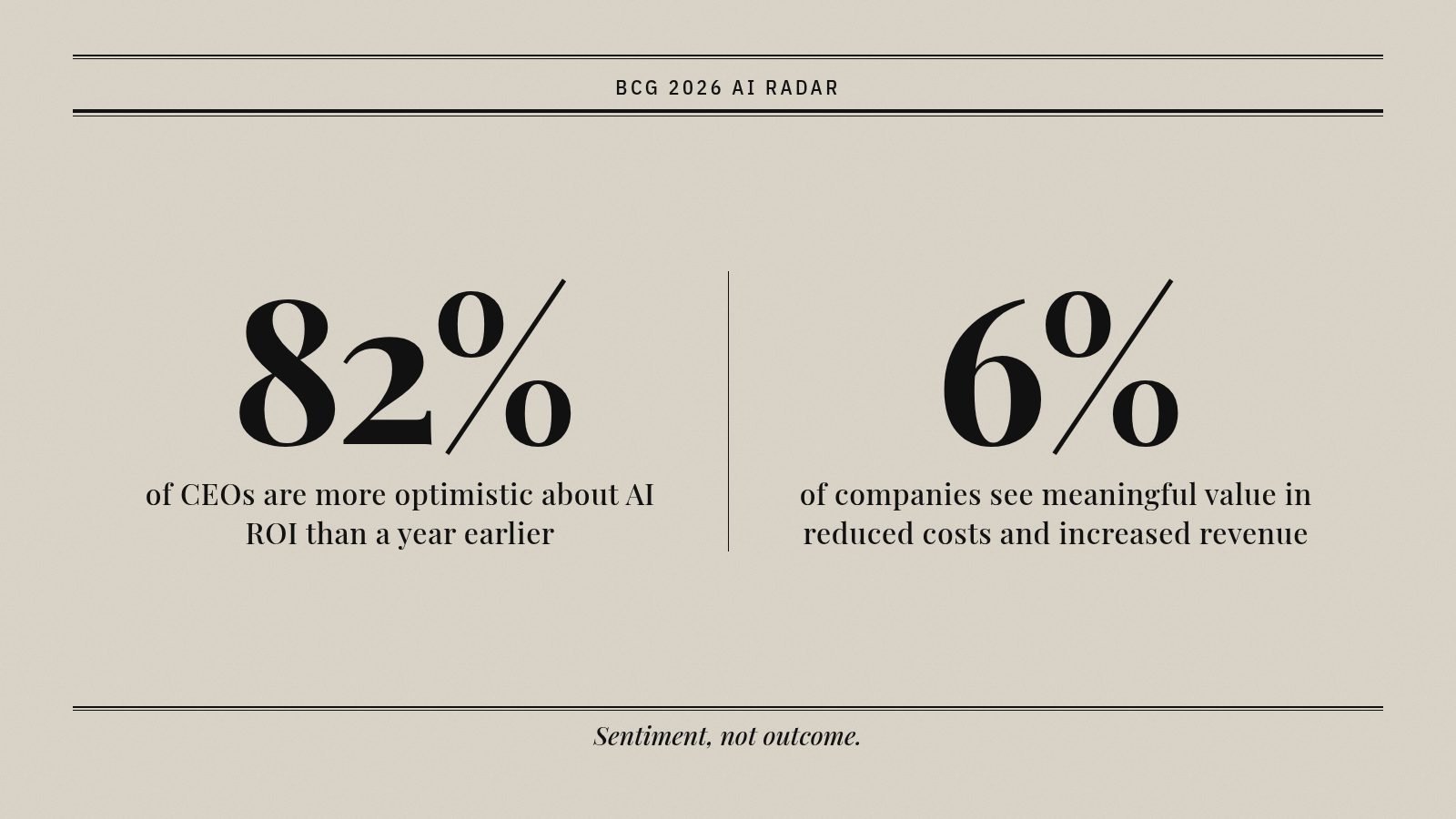
Two numbers open BCG’s 31 August 2026 article, Look Past Productivity to Get Real Value from AI. According to its 2026 AI Radar survey, 82% of CEOs are more optimistic about AI ROI than they were a year ago. A mere 6% of companies, BCG says, are seeing meaningful value “as measured in reduced costs and increased revenue.” The first number is sentiment. The second is an outcome.
That gap is not a surprise if you work in marketing. I keep seeing two corporate extremes.
One extreme is to democratize AI, or, less politely, to spam it well: hand every team an agent — Codex, Workbody, and the like. People get faster, and the organization produces more. Creating more stuff is not the same as creating more value. For most organizations, this can become a slop factory. Trying is now easy, but each try still costs time, resources, investment, and budget, and can add chaos without lifting market cap, enterprise value, or revenue.
The other extreme is to restrain. Firms withhold AI because they do not yet believe it creates value, and because ways of working are already tightly established, so AI adds little at the corporate level. That path can keep earning what the firm already earns, with less chaos. The open risk is whether the model still holds, and whether AI-native workflows produce a black swan.
My judgment is that these are the two ends visible now, and that the useful question is not which tool you handed out. It is whether any of the work shows up on the P&L.
I. Why pilots look like progress
“AI is deceptively easy to deploy,” BCG writes. Companies can launch pilots everywhere and see something that resembles progress: employees work faster, developers produce more code, marketing teams create more content. In many cases, the cost structure does not move.
BCG gives three reasons. First, pilots automate existing tasks rather than the cross-functional process. If that process is already too complex, AI can freeze the complexity in place. One company cut a ten-day task to a day, but customers still waited ten days, because the surrounding process had not changed. Only after it started measuring customer outcomes — not task speed — did it remove committees and intermediate steps.
Second, efficiency gains get reabsorbed. If an activity becomes 20% faster, that time has to be reallocated, or the benefit disappears.
Third, companies measure activity — hours saved, tasks automated — instead of a P&L action: cutting external spend, raising throughput, or removing capacity. Without that link, BCG says, “the value remains theoretical.”
This is the slop-factory mechanism. More drafts, more variants, more tests, and more meetings about those tests. Each try is cheaper to start than it used to be. It is not free. Companies think they are transforming, BCG writes, but they are often doing the same work slightly faster, with the cost base still too high.
II. What the successful 6% do
The companies seeing meaningful value, BCG says, are not doing more. They are going deeper. They concentrate on a small number of initiatives with the largest potential impact, decide where human judgment still creates the most value, and automate the work around it — data gathering, approvals, reporting, forecasting, and execution. They say no to smaller plays that will not move anything that matters.
A manufacturing example makes the filter concrete. A company considered using AI to cut production waste. Waste was less than 1% of cost of goods sold. Even eliminating all of it would not have paid for the solution. Technically feasible, economically immaterial.
The same firms, on BCG’s telling, redesign work end-to-end. They simplify before they automate, and they tie results to the P&L — management layers, outsourcing spend, process complexity, overhead. BCG estimates that AI-enabled transformations can reduce generation and administrative costs by 25% to 35%, R&D costs by 20% to 30%, and sales, marketing, and portions of cost of goods sold by 15% to 35%. Those are estimates on the page, not Radar results, and not a promise.
BCG also reports three cases: a global consumer company that generated €250 million in cost savings and 15% to 20% in P&L efficiency by redesigning marketing workflows and cutting agency spend; a food and beverage company that used AI in procurement to reduce costs by $500 million; and a global technology company that automated more than a million back-office activities, targeting about 30% lower annual operating expense on a $15 billion cost base. “Depth, not breadth, is the differentiator.”
III. In marketing and FMCG, I am still waiting
The consumer-company example is the closest this article comes to a marketing P&L story. On the page, it is a cost story: redesigned workflows, less agency spend, €250 million saved, 15% to 20% better P&L efficiency. It is not a story about revenue per employee, or about a brand that grew because every team got an agent. Revenue is in the 6% definition. It is thinner in the cases BCG chose to publish.
From where I sit, in marketing and FMCG, I am still waiting to see much corporate-level AI that raises productivity or revenue per employee. I have not seen much of it yet. That is a present-tense observation, not a claim that no such company exists, and not a dismissal of BCG’s example.
If BCG is right, the missing middle is not a third slogan. It is a slower operating choice than handing everyone Codex or Workbody, and less tidy than keeping AI out of a process that already works: pick a few end-to-end workflows, redesign the process around the decision, then put AI in, and tie the result to a P&L action.
Closing: The trade-off is not “everyone gets an agent” versus “no one does”
If your team is already producing more content, more tests, and more decks, do not add another agent first. Pick one workflow — campaign production, agency management, insight-to-brief, forecast-to-allocation — and ask whether you are measuring hours saved, or a number that can appear on the P&L. If you cannot name the P&L action, you are still in the pilot that looks like progress.
The conservative extreme has a real advantage: less chaos, and a process that can keep earning. I would not mock it. I would also not treat stability as proof that an AI-native redesign will never arrive from the outside. That black-swan risk remains open, not a prediction.
The judgment
My judgment is that handing every team an agent can raise individual productivity and still leave the P&L untouched — and that, in marketing and FMCG, I have not yet seen much corporate-level AI that clearly raises productivity or revenue per employee.
Three things this week
- Split this week’s AI work into two lists: “more output” (more drafts, more variants, more tests) and “a P&L action” (cut external spend, raise throughput, or remove capacity). Count the items in each list.
- Pick one marketing or commercial workflow you already use AI in, and write down, in one line, whether you are measuring hours saved or a number that can show up in the P&L.
- Name which extreme you are closer to this week — hand agents to every team, or hold AI back because the process is already tight — and name one workflow you would redesign end-to-end if you could choose only one.
If you had to pick one marketing workflow to redesign end-to-end this quarter, which one would it be? Subscribe to Future Insights Lab, or reply with that one workflow.
Link to the original
https://www.bcg.com/publications/2026/why-ai-pilots-rarely-deliver-value
Sources
- BCG, Look Past Productivity to Get Real Value from AI, 31 August 2026: https://www.bcg.com/publications/2026/why-ai-pilots-rarely-deliver-value. The 6% is from BCG’s 2026 AI Radar, defined on that page as meaningful value in reduced costs and increased revenue. The 25%-35% / 20%-30% / 15%-35% ranges are BCG estimates, not Radar results. Sample size and authors are not stated on the page.
Leave a Reply