
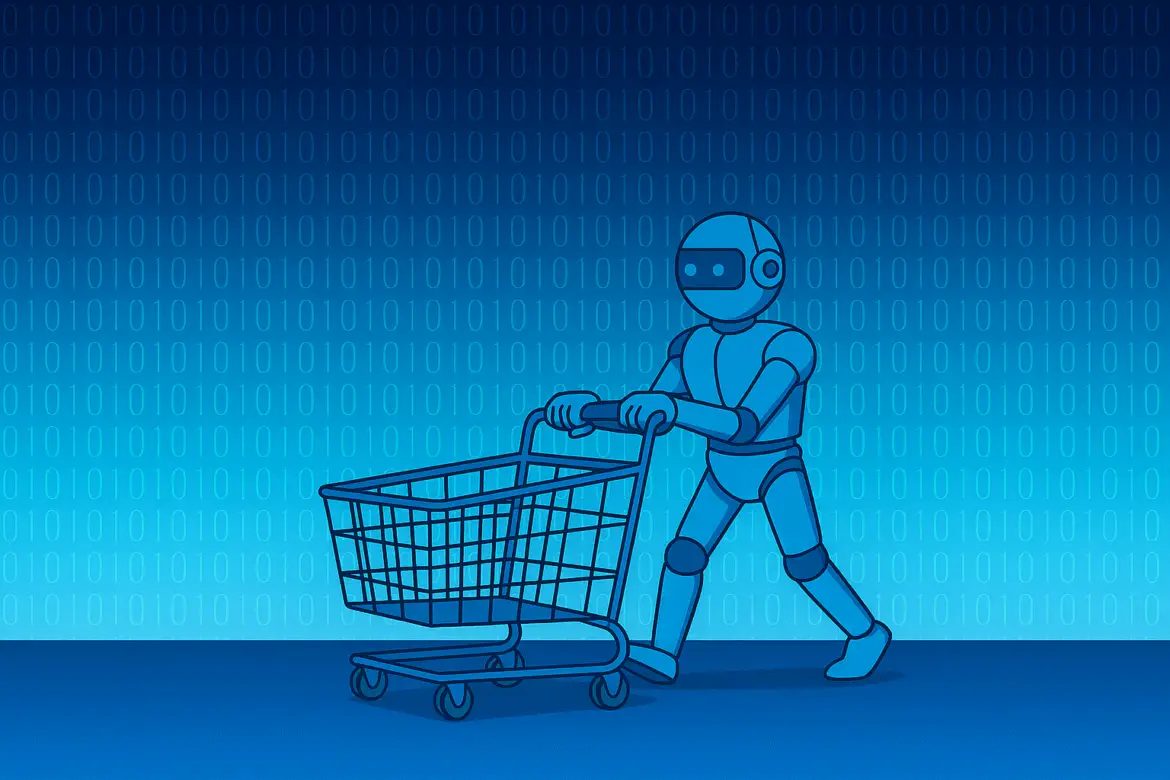
English concept: Shopping Agent · AI Universal Search
Introduction: The endgame of a recommendation system is not being more accurate. It is deciding for you
For the past fifteen years, the basic structure of e-commerce has been composed of “search + a recommendation feed”: search takes on a clear intent; recommendation stimulates a potential interest. After 2024, these two chains are merging into one fast lane of decision. The user does not have to enter a keyword, and does not need to slide past hundreds of cards. A Shopping Agent will, on the basis of your budget, preferences, inventory, and scene, directly generate a shopping plan that “can be executed at once,” and then ask you only one sentence: “Confirm, or revise?” The entrance migrates from the page to the semantic layer; the decision moves from a person to a joint decision of person and machine; the platform also changes from a distributor of traffic into an “operating system” of transaction execution. This is not a fine-tuning of experience. It is a transplant of the commercial logic.
NO° 01 | From “guessing what you like” to “I have already chosen for you”
Every evolution of recommendation technology, on the surface, pursues a higher click-through rate; in fact, it is continuously shortening the chain of decision. When behavioral data, the rhythm of payment, location and weather, calendar signals, and social context are brought into the same semantic space, the system has enough of a prior on “what you are most likely to need now.” Stack on top of that a multimodal model’s semantic understanding of images, video, and voice, and a Shopping Agent can simulate your past logic of comparison, exclude in advance the options you would not accept, and assemble a basket of product combinations that “can be bought today, and can be received today.” Choosing is compressed into confirming; browsing exits the stage; the decision itself becomes a low-friction nod.
For consumers, the gain is obvious: the time of decision falls to the level of seconds, choice fatigue is lightened, and routine work such as restocking, price monitoring, and periodic purchase is changed into automatic execution, so that the rhythm of life and the rhythm of finance are more in step. The true watershed is “the management of exceptions” — when a preference changes, the situation does not fit, or the system misjudges, whether the user can intervene with one click and rewrite the strategy will decide whether trust can last. In other words, a good Shopping Agent is not only good at guessing. It must also be good at explaining “why it guessed this way,” and at accepting your quick correction.
For platforms and brands, the battlefield has also quietly moved house. A platform needs to upgrade “the engineering of traffic” into “the engineering of decision”: no longer take pride in impressions per minute and in time spent, but take as KPIs the hit rate of a plan that is right in one go, the coverage of explainable citation, and the certainty of fulfillment. A brand has to recast product-oriented marketing into a supply strategy of “situational SKUs”: the same need, under different weather, places, and budgets, should have a different combination and promise, and should be opened, in a machine-readable way, for an agent to call.
NO° 02 | Platform entrance 2.0: from a traffic atrium to an “agent socket”
When the decision moves forward to the agent, the importance of a platform homepage and of a channel page naturally falls. The true entrance becomes a set of low-latency, high-reliability APIs and data contracts: an intent comes in, and inventory, price, service, and a delivery window are immediately filled back; an answer goes out, and payment, invoice, customer service, and returns and exchanges are strung on in sync. The platform transforms from a “plaza of content distribution” into a “hub of transaction execution,” like an e-commerce operating system inside a super-app, responsible for folding many life services and retail scenes into a “set of actions” that an agent can dispatch in one go.
This turn asks far more of a platform’s infrastructure than a traditional feed. First is the governance of the semantic layer: unify the standard of attributes across categories and services, or the agent, when comparing price and quality, will sink into a data mire of “the same name, a different meaning.” Second is the modeling of fulfillment certainty: not only quote a price, but also report “whether it can be on time, how to compensate if the promise is missed, and how an alternative is switched,” because an agent, when choosing a supplier, will count in risk and the cost of rollback. Finally, observational execution and audit: every parsing of an intent, every call of a tool, every anomaly of an order, must have a traceable log and a chain that can be replayed. This is needed for risk control, and is also the basis of a “human–machine protocol” between the platform and the brand.
Under this structure, competition among platforms no longer stops at price and subsidy. It is who can provide a more stable semantic interface, a richer coverage of scenes, and a lower latency. The data moat also moves from “who holds more behavioral data” to “who holds a more complete global semantics and a highly available fulfillment.” The contest for the entrance is still there, but the shape of the entrance has already changed.
NO° 03 | The brand’s battlefield: from fighting for an ad slot to winning an “intelligent negotiation”
In a recommendation logic led by an agent, exposure is not whoever bids higher, and the choice is not whoever has a higher CTR. Brands will compete on a three-dimensional coordinate of “a trust score × a degree of fit × a fulfillment promise.” The agent will, in the background, complete a round of “intelligent negotiation” for the user: do you provide verifiable specifications and evidence of materials; can you promise arrival in my delivery window; can the price be adjusted within a range my budget can accept; is there a clear, machine-readable remedy for after-sales. Only a brand that can meet these conditions will enter the candidate list; those that cannot will be silently eliminated, and you may not even see the reason for being eliminated.
The focus of a brand’s digitalization therefore has to upgrade from “listing on many platforms” to “a machine-readable brand”: completely annotate objective attributes and scene indexes with structured data; publish machine-readable terms of warranty, returns and exchanges, and a repair SLA; and, for promotions and pairings, provide an explainable rule, not only a poster. Marketing KPIs must also turn to a combination of “the rate of being chosen, the conversion rate, and a fulfillment score,” and not only look at exposure and clicks. On the internal organization, product planning, legal, customer service, and data engineering have to join the same “negotiation chain”: planning defines a real combination that can be sold; legal standardizes and structures the terms of the promise; customer service provides a library of solutions that can be cited; data engineering makes sure all information can be called in real time and written back.
In the long run, an advantaged brand will turn “trust in a persona” into “trust in data”: long-term reviews, the rate of defects, after-sales satisfaction, and cases of service remedy all become weights when an agent decides. It looks cold, and is in fact fairer. The only cost is that you must replace a one-off packaged narrative with a continuing ability to be verified.
NO° 04 | The experience at the user end: shopping is “made invisible,” and the situation is “done in one step”
When restocking, periodic purchase, price monitoring, and the redemption of benefits are taken over, shopping will change from a front-stage behavior into a back-stage task. You may only step in in two situations: one is an exceptional situation, such as a temporary change of place or a need for a special occasion; the other is an update of strategy, such as a tightening of this month’s budget, or a turn of preference toward health or low-carbon goods. The rest of the time, the agent will, in a place you cannot see, run many micro-decisions for you, and, before settlement, present, on an “explainable voucher,” “why this basket was chosen.” What truly matters is letting the user have a clear and easy master control: from a ceiling on the total to a brand black-and-white list, from a delivery window to the order of priority for substitutes, all can be adjusted quickly in a sentence, and every adjustment will be absorbed by the system and become prior knowledge for the next decision.
The commercial consequence of this “invisible consumption” is that competition between platforms and brands moves to the operating layer behind. Whoever has a more stable “automatic-order experience,” a cleaner “handling of exceptions,” and can, when out of stock, provide a more reasonable substitute and compensation, will continue to be preferred by the agent. The focus of complaints will also change — from “the goods arrived late” to “whether an AI purchase on one’s behalf is transparent and controllable.” A dashboard of transparency and a rollback mechanism are therefore not only a requirement of compliance. They are also the base of a new generation of trust.
NO° 05 | A further evolution of content and marketing: from catching the eye to “being citable by a machine”
In the content ecology of a Shopping Agent, whether you can be cited and retrieved directly decides the efficiency of reach. Livestreams, short videos, long reviews, Q&A, and tutorials are no longer only “persuading a person.” They must also “persuade a machine.” This requires that all content, at the moment it is produced, be sliced, vectorized, and tagged: a video must have a verbatim transcript and a chapter summary; an image must have tags of person / scene and of product attributes; a long piece must have structured citations of evidence and a timestamp. When content attends both to human narrative and to the standard of machine retrieval, an agent can, with higher confidence, bring your material into the reason for a recommendation, and form an “explainable quotation.” For a KOL, commercial value will move from traffic to “the rate of being cited by an agent” and “the contribution of the gain from quotation to a conversion.” For a brand, the content supply chain must be treated as data engineering: rather than make ten more short films that cannot be cited, let one “long test + tutorial” that can be cited repeatedly appear, in a long tail, among ten thousand answers.
This will also rewrite marketing’s system of evaluation. CTR and completion rate still matter, but they will recede to the second line; “the rate of being chosen, cite-ability, the consistency of provenance, the latency of a first answer, and the acceptance rate of an alternative” will rise as the new core metrics. These sound very much like engineering, but their distance from brand power is closer than you think — because in a world led by an agent, the embodiment of brand power is that you are cited repeatedly, and it does not feel out of place.
Closing: A Shopping Agent is e-commerce’s new operating system
For consumers, it turns “browsing” into “being served,” and frees the mind and the attention from the slide of looking for a bargain. For platforms, it turns “distribution” into “agency,” holds the entrance of intent and the last mile of fulfillment, and is like a transaction data center facing the agent. For brands, it turns “media spend” into “a negotiation of trust,” and machine-readable service and the transparency of data become core competitiveness. For content producers, it turns “seeding and selling” into “training the agent”; only what is written clearly, with rigorous evidence, and can be cited, has long-tail value. When the entrance of decision is taken over by AI, the winner of the next reshuffle will no longer be whoever can afford the traffic, but whoever first becomes the preferred answer an agent recognizes.
More deep-dive pieces
- ChatGPT will now show brands how often they are mentioned. That is not proof they were recommended well.
- AI will not only eliminate people: the functions being enhanced, and a manager’s handbook for this week
- AI unemployment ranking: the high-risk functions most likely to be eliminated or largely replaced
- Will AI cause unemployment? Start with the enhance / accelerate / eliminate axes
The judgment, restated
My judgment is that the right to decide in e-commerce is being handed to AI; if a brand cannot become an agent’s preferred answer, traffic and seeding will both lose their effect.
Three things this week
- Turn a set of core SKUs into data cards that can be cited by a machine.
- Test the certainty of fulfillment (whether inventory / timing / returns and exchanges can be machine-read).
- Put up a board of “the rate of being chosen,” and stop looking only at clicks and impressions.
If you are preparing to be chosen by a Shopping Agent, you are welcome to subscribe to Future Insights Lab, or to reply and discuss the sticking points of cite-ability.