
English concept: Agent Orchestration · Agent Stack
Keywords: Agent Stack, intent orchestration, feedback loop, no-human-intervention workflow
NO°00|“One person = an AI team”: from a flourish to a production line
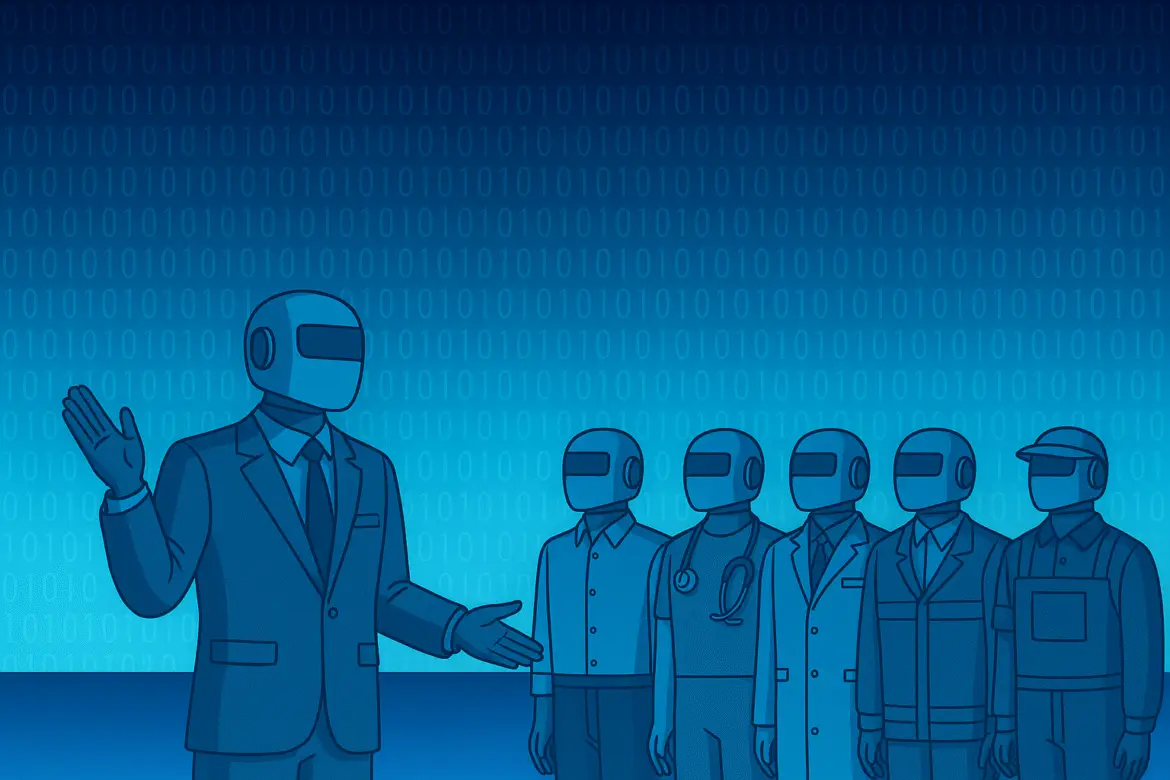
Two years ago, most teams treated Copilot as an accelerator: write a piece of copy, fill in a few lines of SQL, make a slide deck. The output was faster, but people were still the main axis. Now, on the floors of e-commerce, SaaS, financial holding groups, and manufacturing in Taiwan, more and more companies are beginning to form teams of several “specialized little assistants”: one fetches data, one cleans it, one summarizes, one checks compliance, one publishes. The subject of collaboration has quietly shifted from “person ↔ machine” to “machine ↔ machine.” Human beings step back to the front of the house, and concentrate on defining the intent, setting the boundary, and signing off.
This shift is not a simple stacking of tools. It is a change of generation in the relations of production. When every link is cut into a clear duty, and different models and strategies can be swapped in, the process acquires the properties of being observable, rollback-able, and auditable. AI is no longer a “spark of inspiration.” It is a “governable network of capability,” moving from the demonstration stage onto the production roster.
Being able to use AI is no longer scarce. Being able to manage a group of AIs and have them deliver steadily — that is the hard currency of the new workplace. The scale that measures value also moves from “who writes faster” to “who makes the whole chain more stable, more economical, and more compliant.”
NO°01|From a single Copilot to a dedicated Agent Stack: division of labor, isolation, and traceability
A single Copilot looks all-purpose, but in practice it is like putting every process into one large pot; once the output drifts, it is hard to locate which step went wrong. Cut the work into a minimum executable unit (MEU), let each agent be responsible for only one or two clear tasks, and write, for every step, the input format, the standard of acceptance, the conditions of failure, and the rollback strategy, and observability and maintainability will rise markedly. Take campaign marketing as an example: a data agent periodically extracts competitor prices and inventory; a data-processing agent deduplicates and detects anomalies; an insight agent produces a conversion list from gross margin and conversion rate; a compliance agent checks advertising law and the brand’s forbidden phrases; a publishing agent syncs on-site placements and message channels.
The isolation of permissions and of stages is the second key. Drafting can be fully automatic; sending anything outward must have a second authorization. Cross-domain reads must pass a gateway audit. Any step that can change the customer experience must leave a traceable fingerprint of the operation. This lets errors converge inside a small circle, and avoids the chain reaction of “a small model slips, and every channel is buried with it.”
For consumers, the speed of response is more stable, the spillover of errors is smaller, and personalization can be refined to “region / segment / time of day.” For the organization, an Agent Catalog becomes an underlying asset like a headcount establishment. The mode of production moves from a hand-off relay to a flowing production line, and the measure of performance also moves from “people efficiency” to “chain efficiency” — success rate, end-to-end latency, unit-task cost, and first-pass rate.
NO°02|Intent → dispatch → feedback: press a fuzzy vision into a chain that can run
The real difficulty of multi-agent systems is not “can it run,” but “can it keep running.” The first step is intent engineering: press a fuzzy proposition such as “make a launch plan for a new product” into an intent matrix — clearly mark the goal, the sub-goals, the sub-tasks that can be accepted, the data sources required, and the authoritative standard, and stipulate in advance “when it should refuse to answer or issue a clarification.” Only when the intent is clear can you talk about scoring and optimization.
The second step is the topology of dispatch. Which nodes run in series, which can run in parallel, which need a conditional fork and a timeout plan — every step is given a rollback strategy (a more conservative model, a narrower task scope, or a hand-back to a person). Only after the topology is written as a basic template can it be reused across projects, so that you do not have to pull the wires from scratch every time, and step in the same pits every time.
The third step is a closed loop of feedback. A node’s output is scored in real time; if it does not meet the threshold, first use RAG to retrieve supporting evidence and then generate again; if it still falls short, trigger a human review, and at the same time put the failed sample into the store as later training data. When scores, reasons for failure, and means of repair are all recorded over time, the chain will “run smarter and smarter,” not “run more and more by chance.”
NO°03|The iron rules of A2A collaboration: a structured interface + a unified data layer + observability
When agents collaborate with one another, the thing to avoid most is treating “chat” as the bus. Natural language has a high degree of freedom and poor stability; over time it causes semantic drift and an inability to trace back. A2A should take a structured interface contract as its first principle (JSON Schema / a Pydantic model), with fields, units, and enumerated values all listed plainly. Typos, filler, and surplus modifiers should all be normalized at the entrance, so that downstream cannot fail to parse them.
The data layer then takes a shared vector namespace as its hub. Across agents you do not pass the full text, only an embedding ID and a version; pulling the original text is the responsibility of a unified knowledge layer. This both lowers latency and shrinks the surface of data leakage. Only when knowledge updates have versioning, a canary, and a rollback mechanism will the semantic consistency of A2A be stable.
Observability must go to the cloud. Every execution produces a Trace-ID; latency, failures, and token usage go to a dashboard. When a node is abnormal, first trip a circuit breaker and roll back to a next-best strategy, or put the item in a human to-do list, so that the whole chain does not seize up. This rigor makes the output more explainable. An answer comes with an explanation card of “basis ××, confidence ××%, last updated ××,” which is friendly to compliance, and which also puts the customer more at ease.
NO°04|Orchestrator: the mid-level’s passing skill is “chain efficiency,” not “headcount”
In the multi-agent age, mid-level value is no longer shown by “controlling the schedule and asking for a report,” but by designing a chain that can run and by continuously optimizing it. A qualified agent orchestrator does not spend the day writing copy. They align the goal with the business and press the need into an intent matrix; they define authoritative sources and red-line domains with data and legal; they choose a template, deploy the orchestration, and set the SLA and the refusals; they watch the dashboard, look at success rate and first-pass rate, and assess unit-task cost.
This role fuses product, data, engineering, compliance, and operations. A good orchestrator can turn “experience” into an engineering asset that can be reused: an intent map, an evaluation set, replay cases, rollback strategies, and coaching comments. When these assets are put into a shared warehouse, the rate of reuse across departments and the speed of going live will rise exponentially.
The credentials for promotion will also be rewritten. In the past the question was “how many people have you led.” In the future the question will be: “the Agent Stack you designed recently — what is its success rate? its first-pass rate? its unit-task cost? When it fails, how does it roll back automatically?” Behind the answer is a whole professional literacy centered on chain efficiency.
NO°05|From budget to compliance to culture: the transformation has to upgrade three things together
Bringing in a multi-agent system is not buying software. It is a three-way linkage of the organization’s institutions. On the budget side, you have to build a cost center for tokens and call volume, and treat inference cost like a cloud resource — with a quota, an alert, and a way to press it down — so that you avoid an emotional argument that “AI is expensive.” You also have to align cost with value, and hang “unit-task cost” together with “first-pass rate,” so that saving and improving effectiveness appear on the same sheet.
On the compliance side, you have to set a red-line domain for private inference or a local GPU; everything that calls out is desensitized; the process is moved entirely to least privilege + an audit log. Any action that can affect a customer’s rights must leave, on the audit panel, a time, a source, a version, and a person responsible. Without this basic governance, any “automation” is only an amplifier of risk.
On the culture side, you have to move from “send someone to fight the fire” to “ask for a template, a replay, a baseline, an A/B.” Weekly meetings and OKRs look instead at the coverage of automation, the SLO of the chain, and unit-task cost. Errors are treated as a signal for improvement, not as material for blame. When departments discuss quality and cost in the same language of measurement, decisions can be fast and consistent.
NO°06|Anti-patterns: why your agents can never “graduate”
The most common failure is stuffing everything into a large prompt. This looks like a saving of trouble, and in fact enlarges the black box; when something goes wrong there is no way to locate it or repair it, and a change of model means starting over. The second trap is treating chat as the bus, and letting agents toss natural-language sentences at one another: it runs today and is entirely broken tomorrow, and the team is worn out tuning parameters without being able to catch the main cause.
The third problem is having no version and schema governance. When new fields and changes to enumerated values have no versioning strategy, half the chain is dragged down; when the knowledge base has no versioning, canary, or rollback, the stability of RAG can only depend on luck. Finally, treating people as the last line of defense rather than as testing in advance is also a mine: without an evaluation set, a red-team question bank, or a replay mechanism, you can only fall back on overtime and prayer.
What these anti-patterns have in common is giving “engineering” over to “a sense of being there in the moment.” As long as you add an intent matrix, a structured interface, version governance, RAG provenance, and observability, most cases of “never graduating” can, within two iterations, be restored to a runnable state.
Closing|The unit of collaboration moves from “a person” to an “agent ecology”; competitiveness moves from “people efficiency” to “chain efficiency”
At the individual level, the combination of understanding the business and understanding the chain will become the scarcest function. At the team level, one orchestrator + several specialized agents will be the new normal. At the organization level, whoever first templates experience, standardizes the chain, and makes quality observable will be able, more quickly, more steadily, and more economically, to turn AI into an auditable productivity.
When you can direct dispatch with intent engineering, steady quality with structure and RAG, and hold the boundary with versions and audit, AI can move from an “inspiration plugin” to a “reliable colleague.” The next time you interview, what truly matters is not how many people you have led, but: how steadily, how quickly, and how economically the Agent Stack you designed is running.
The real superpower is not being able to write a prompt. It is being able to turn a goal into a chain, a chain into an asset, and an asset into a widening moat.
More deep-dive pieces
- ChatGPT will now show brands how often they are mentioned. That is not proof they were recommended well.
- AI will not only eliminate people: the functions being enhanced, and a manager’s handbook for this week
- AI unemployment ranking: the high-risk functions most likely to be eliminated or largely replaced
- Will AI cause unemployment? Start with the enhance / accelerate / eliminate axes
The judgment, restated
My judgment is that being able to use a single-point Copilot is not enough; only the people who can orchestrate an Agent Stack turn AI from a flourish into a production line.
Three things this week
- Draw one “intent → multi-agent orchestration” chain (who fetches the data, who summarizes, who checks compliance).
- Set observable metrics: first-pass rate / rate of exceptional intervention / token cost.
- Run one rollback drill (how the chain is downgraded to a person when it fails).
If you are assembling your first agent production line, you are welcome to subscribe to Future Insights Lab, or to reply and discuss your sticking points in orchestration.